

Have you ever reacted strongly to something and then wondered afterward:
“Was I right … or did I overreact?”
Maybe it was a comment that rubbed you the wrong way.
An email that left you tense for hours.
A small mistake that felt far bigger than it should have.
In the moment, the reaction feels automatic. Later, when things settle, the question often comes:
Why did that affect me so much?
Many people assume overreacting means they are too sensitive, too emotional, or not coping well enough. But strong reactions are rarely about weakness. More often, they are signs that a previously learned stress reaction has been activated.
And often, that activation involves mental imagery — whether you are aware of it or not.
What Does It Mean to Overreact?
We tend to label something as reacting strongly when:
- The response feels bigger than the situation
- The reaction rises quickly and intensely
- It takes a long time to settle afterward
- We feel regret once the moment has passed
You might recognize this in everyday situations:
- Feeling defensive when receiving feedback
- Losing your cool over the same issue repeatedly
- Withdrawing or shutting down during tension
- Replaying a conversation long after it ends
Afterward, many people turn their frustration inward:
“Why am I like this?”
“Why can’t I just let it go?”
But this rarely leads to clarity. It leads to self-criticism.
A more helpful question might be: What was activated in that moment?
Stress Reactions Often Don’t Start Where We Think
It’s easy to believe that our reactions are caused entirely by what just happened — by something external to us, the other person or the situation.
A comment.
A tone of voice.
An unexpected problem.
These are visible triggers. But strong reactions often don’t begin there alone.
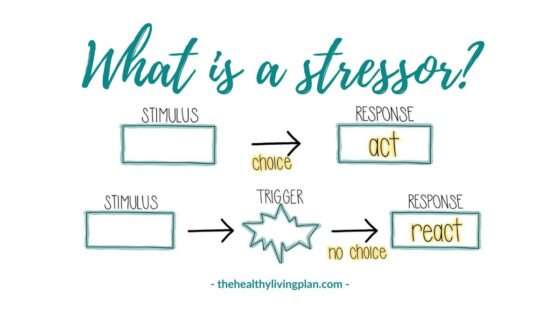
Think about how some people react strongly in a situation while others remain calm.
The situation is the same for all. How each person responds is not.
Between the stimulus and the response, there is a space.
And sometimes we feel there is no space.
The question becomes: What is blocking the space?
This is where stressors such as mental imagery begin to play an important role.
The Hidden Role of Mental Imagery
Mental imagery isn’t just daydreaming or imagination. It includes images, sounds, and other sensory representations that you may recognize as memories, beliefs, and expectations that shape how we experience the world.
Mental imagery can be:
- A memory of being criticized
- A belief that everyone should work hard
- An expectation of failure
- A brief flash of something that once felt threatening
These images don’t always appear clearly or consciously. Sometimes they happen so quickly that we only notice the reaction, not the imagery that was activated.
For example: Someone offers feedback at work.
In a split second, an image of past criticism may be activated — perhaps from years ago. Even if the present feedback is calm and constructive, the body reacts as if the earlier experience is happening again.
Or imagine preparing to speak in front of others.
A memory of your first time on stage flashes briefly. The body tightens. The heart races. Thoughts shift toward doubt. The reaction feels immediate — but it didn’t come from nowhere.
It came from what was activated in the moment.
Even brief or hidden mental imagery can influence thoughts, physical sensations, and emotional responses before we have time to think logically.
Why Reactions Feel So Fast and Intense
Many people are surprised by how quickly reactions happen.
One moment feels calm.
The next moment feels overwhelming.
Mental imagery helps explain this speed. This occurs at an energetic level, which can immediately activate thoughts, emotions, and physical sensations.
You may notice:
- Defending yourself before listening fully
- Withdrawing from a conversation
- Trying to control the situation
- Becoming emotional without fully understanding why
These reactions are not random. Often, you may feel as if you are reexperiencing elements of an earlier event. The intensity reflects not just the present situation, but earlier experiences connected to it.
When “Am I Overreacting?” Becomes a Turning Point
The question “Am I overreacting?” can feel critical — but it can also become a powerful turning point.
Instead of judging yourself, you can shift into curiosity.
Not: What’s wrong with me?
But: What was activated in that moment?
That shift can change how you think of stress reactions.
It moves attention from blame to understanding and from constant battle to noticing underlying patterns. And often, what emerges is awareness that these reactions are not who you are. They are stress reactions that have been activated.
How Can Mental Imagery Shift?
Recognizing that memories and beliefs are being activated in the moment is often not enough to shift reactive patterns.
It is helpful to know that the underlying mental imagery can shift so that it no longer triggers strong reactions.
While you cannot change what happened in the past, you can shift the memories of what happened.
Logosynthesis® offers a powerful model with simple, repeatable techniques to do this work — layer by layer — allowing patterned stress reactions to shift and release.
Reactions that once felt overwhelming begin to feel more manageable. Situations that once triggered strong responses become easier to navigate.
People often notice:
- More ease and freedom to choose how they respond to situations
- Less intensity in emotional, mental, and physical reactions
- Faster recovery after difficult moments
- Improved relationships
Not because they forced themselves to stay calm — but because the triggering patterns have shifted.
Am I Overreacting? My Personal Experience
I was introduced to Logosynthesis during a very busy time in my life—working in a corporate job, co-owning a pharmacy with my husband, volunteering in the community, and fulfilling roles as a mother, daughter, sister, and friend.
Looking back, there were signs, such as tight shoulders, tension in my jaw, and reactions that came faster than I expected. Life was full, and I didn’t think I was stressed. Yet, I would admit that at times I reacted more strongly than I intended.
I started using the Logosynthesis Basic Procedure when I paused to notice that things bothered me—such as other people not doing things the way I thought they should, or simply when I noticed a clenched jaw or an abrupt tone of voice.
Not only did I feel calmer, but my coworkers did too. It even became a bit of a joke:
“Oops, I just overreacted. I guess I have some work to do.”
And over time, that subtly yet powerfully changed everything for me.
I began to shift from focusing on controlling situations to changing my automatic reactions in those situations.
I’ll admit it was not always easy, especially because I believed I was right at the time. But with a healthy dose of humour and curiosity, longstanding patterns began to shift. And over time, I found myself able to ask more easily:
“Am I overreacting?”
That simple question created space to notice what had been activated and to choose a different response.
A Gentle Reflection
You might take a moment now to reflect on a recent situation.
A moment when you wondered if you overreacted.
Consider:
- What happened?
- What did you feel in your body?
- What self-talk did you experience?
- Did anything from the past feel connected to that moment, even briefly?
There’s no need to analyze deeply — simply noticing can be enough to begin understanding patterns that once felt automatic.
A Different Way to Understand Strong Reactions
Strong reactions are often misunderstood. They are labelled as oversensitivity, lack of control, or poor coping.
But in many cases, they are signals that something energetically has been activated.
When we begin to understand the role of mental imagery in stress reactions, our relationship with those reactions changes.
Instead of fighting them or judging ourselves, we become curious. We begin to recognize that reactions are not random. They are connected to experiences, memories, and expectations that still hold energy.
And when those triggering memories shift, our responses begin to shift as well.
The next time you find yourself wondering:
“Am I overreacting?”
Pause for a moment.
Not to judge yourself — but to notice.
Because sometimes the strongest reactions are not signs of weakness, but invitations to understand what has been activated in your space.
If this reflection resonates with you, you might begin by noticing moments when strong reactions arise and gently asking:
What was activated in my space just now?